In the harsh operating conditions of petrochemical, coal chemical, and power industries, control valve trims (valve cores, valve seats) act as the direct “commanders” of fluid flow. They face long-term challenges from high-speed erosion, particle wear, and cavitation. If the trim’s sealing surface fails, it can cause valve internal leakage, system shutdowns, or even safety accidents. That’s why surface hardening is a key technology to extend valve service life. Learn how to choose the right surface hardening process for control valve trims to reduce maintenance costs and extend service life.
Today, the two most widely used surface hardening processes for control valve trims are cobalt-based alloy (Stellite 6) overlay welding and tungsten carbide (WC) spraying. This article compares these two technologies in detail—covering material properties, wear resistance mechanisms, applicable conditions, and life-cycle costs—to help engineers make informed selection decisions.
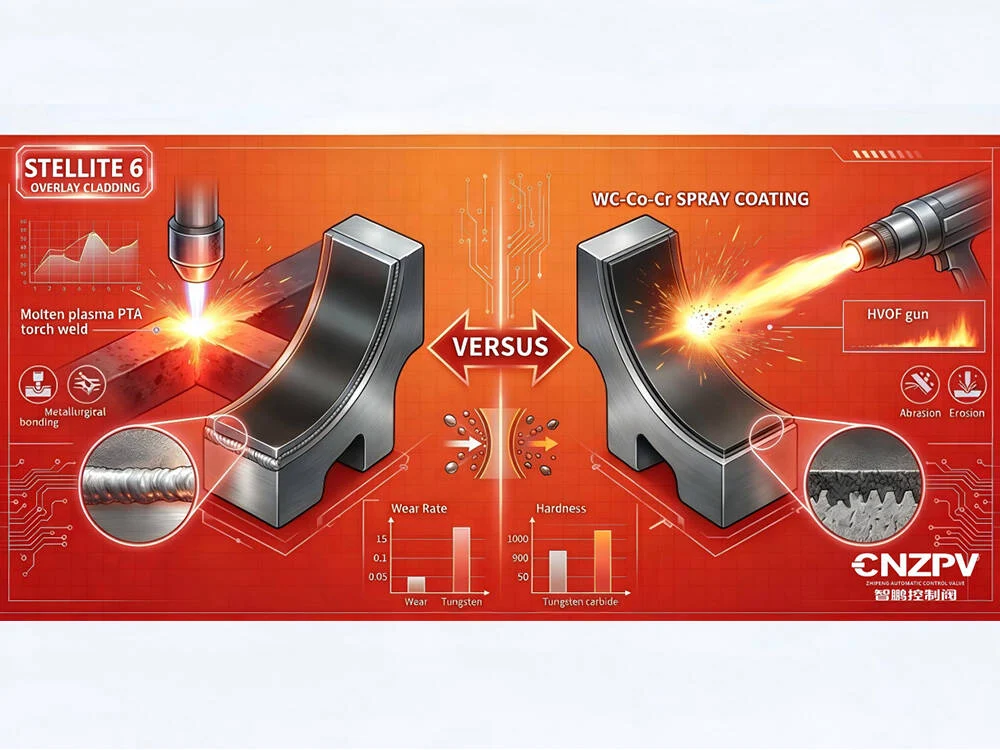
1. Key Features of Two Mainstream Hardening Processes
1.1 Stellite 6 Overlay Welding: Classic Metallurgical Bonding
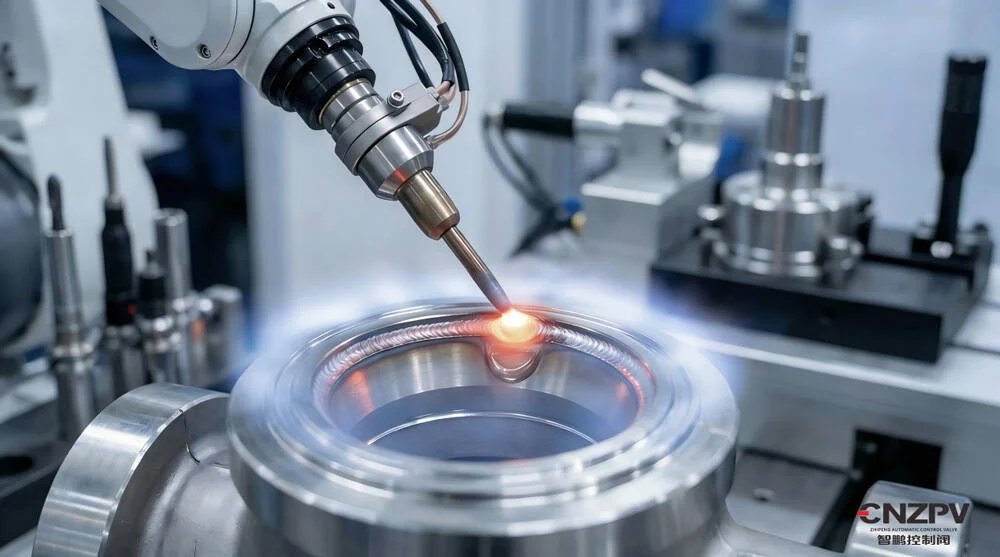
Stellite 6 is a cobalt-chromium-tungsten (Co-Cr-W) alloy. Its typical composition (by mass) includes 27-31% Cr, 4-6% W, 0.9-1.4% C, and Co as the base metal. Using Plasma Transferred Arc (PTA) or TIG welding, alloy powder is melted by arc heat and deposited on the substrate. This forms a metallurgically bonded overlay layer, usually 1.5-3mm thick.
Microstructure: High-hardness carbides (such as M₆C, M₂₃C₆) and intermetallic compounds are uniformly distributed on a hard cobalt-chromium solid solution matrix.
Core Advantages: It offers extremely high bonding strength, good impact toughness, excellent thermal fatigue resistance, and strong high-temperature oxidation resistance.
1.2 Tungsten Carbide Spraying: The Hardest Wear-Resistant Option
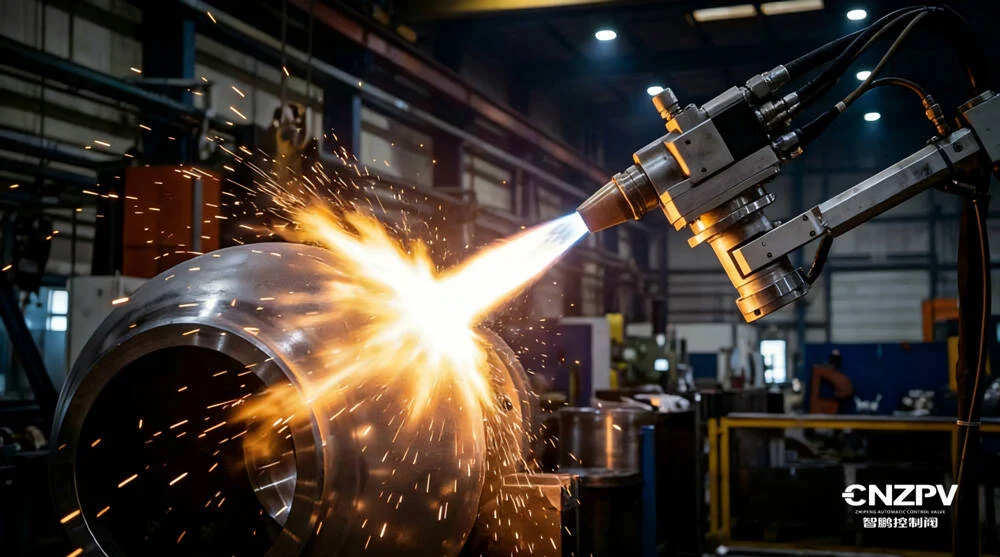
Tungsten carbide coatings are typically made using the High-Velocity Oxy-Fuel (HVOF) spraying process. The spray powder consists of tungsten carbide (WC) particles and a metal binder phase (Co or Co-Cr). HVOF heats the powder to a molten or semi-molten state, which then impacts the substrate at several times the speed of sound to form a dense “mechanical + micro-metallurgical” bonded coating.
Microstructure: Extremely hard WC particles (hardness up to 2200-3000 HV) are embedded in a relatively tough Co-Cr alloy binder phase.
Core Advantages: It has extremely high macro hardness (usually HRC 60-70 or higher), making it the “hardness king” among all hard-facing alloys for control valve trims.
2. Wear Resistance Comparison: Hardness Isn’t Everything
Control valve trim failure often stems from three main types of wear: abrasive wear, erosion wear, and cavitation damage. The two hardening processes perform differently against these wear mechanisms.
2.1 Hardness and Abrasive Wear Resistance
Classic wear theory states that a material’s abrasive wear resistance is proportional to its hardness.
Tungsten Carbide Spraying: Coating hardness can reach HRC 65 or higher, even close to HRC 75. In media with high-hardness particles (like silica sand or coal cinder), tungsten carbide acts as “armor” to resist particle micro-cutting. Data shows that under black water conditions with 30-40% solid content, tungsten carbide’s wear rate is only 1/3 to 1/5 that of Stellite 6.
Stellite 6 Overlay Welding: Its normal hardness is HRC 38-44, and even with multi-layer welding or process adjustments, it maxes out at around HRC 52. When exposed to high-hardness particles (such as quartz sand, ~HRC 60), Stellite 6’s soft matrix easily lets particles embed or cause plowing, creating “crescent-shaped” scouring grooves.
2.2 Erosion and Cavitation Resistance
Stellite 6’s Toughness Advantage: For cavitation resistance (caused by micro-jet impact from bubble collapse), Stellite 6’s cobalt-based austenitic structure provides good work hardening ability. It absorbs impact energy, performing better than brittle materials in early cavitation stages.
Tungsten Carbide’s Brittleness Challenge: While extremely hard, traditional sintered tungsten carbide is relatively brittle. Under high-pressure difference flashing conditions, repeated high-speed droplet impacts can cause tungsten carbide grains to spall. However, modern HVOF-sprayed tungsten carbide coatings—with optimized Co-Cr binder phases and spraying processes—offer improved toughness and significantly better erosion resistance.
3. Key Performance Data & Working Condition Adaptation
To clearly show the differences between the two processes, here’s measured data from coal chemical black water control valves:
| Comparison Dimension | Stellite 6 Overlay Welding | Tungsten Carbide Spraying/Sintering |
| Typical Hardness | 42-48 HRC | 65-75 HRC (HVOF Coating) / 89-92 HRA (Sintering) |
| Abrasive Wear Resistance | Benchmark (wear rate = 1) | Wear rate reduced by 3-5 times |
| Erosion Resistance | Low, prone to honeycomb erosion pits | High, smooth surface, strong cutting resistance |
| Bonding Strength | Metallurgical bonding (extremely high strength) | Mechanical/micro-metallurgical bonding (depends on spraying process) |
| Temperature Resistance | ≤800°C (excellent high-temperature performance) | ≤500-600°C (limited by binder phase softening) |
| Typical Service Life | 3-6 months (needs repair welding) | ≥12 months (even longer) |
Selection Guide for Control Valve Trims
Choose Stellite 6 Overlay Welding: Ideal for high-temperature, high-pressure steam (cavitation), severe temperature fluctuations, or slight mechanical impact. Common applications include power station bypass valves and high-temperature heat transfer oil valves.
Choose Tungsten Carbide Spraying: Best for harsh conditions with hard solid particles, such as coal chemical slag lock valves, black water control valves, and slurry transport valves. When media flow is extremely high and contains abrasive particles, tungsten carbide is the top choice to extend valve maintenance cycles.
4. Process Defects & Repairability
Every technology has limitations. Understanding these defects helps you make better decisions for your control valve trim hardening needs.
4.1 Stellite 6: Dilution Rate Issue
During overlay welding, substrate materials (like stainless steel) melt and mix with the deposited metal, forming a “dilution layer.” Poorly controlled welding parameters can lead to excessive iron penetration into the Stellite layer, reducing its hardness and corrosion resistance. For this reason, PTA (Plasma Transferred Arc) overlay welding is the mainstream process for Stellite 6—it offers low dilution rates and high deposition efficiency.
4.2 Tungsten Carbide: Decarburization & Bonding Risks
Poor temperature control during HVOF spraying can cause tungsten carbide decarburization. This creates brittle W₂C or η phases, which reduce coating performance. Additionally, while the coating bonds firmly to the substrate, it’s not a complete metallurgical bond. Extreme impact loads or edge collisions may cause local spalling.
4.3 Repair Costs Comparison
Stellite 6: Easy on-site repairability. After wear, it can be repaired with TIG welding and reused after grinding. However, multiple repair welds may cause cracks in the heat-affected zone.
Tungsten Carbide: Cannot be repaired on-site if the coating is damaged. It must be returned to the factory to remove the old coating and re-spray. While the repair process is complex, it has a much longer service life between repairs.
5. Conclusion: Symbiosis, Not Substitution
Stellite 6 and tungsten carbide are not competitors—they complement each other for control valve trim surface hardening.
If your application involves “high temperature + impact + cavitation,” Stellite 6’s toughness and high-temperature stability remain unmatched.
If your main challenge is “particle scouring + frequent replacements,” tungsten carbide spraying’s extended service life will reduce shutdown time and maintenance costs.
With advances in thermal spraying and laser cladding technology, future solutions will include “gradient coatings”—a Stellite transition layer combined with a tungsten carbide surface layer. This balances toughness and hardness for optimal performance. For engineers, there’s no “best” technology—only the best fit for your specific working conditions.
If you need personalized advice on control valve trim surface hardening, contact our engineering team for a free consultation. We help you select the most suitable hardening process based on your actual working conditions to maximize valve service life and minimize maintenance costs.